
An Essay on the Ways of The Flowers
In this month's journal, we're exploring how flowers, traditions and beliefs intertwine. A collar of petals and leaves sewn to papyrus in the Egyptian Valley of the Kings. A Chinese Ming official who left his office to cultivate flowers. Families of Santa Elena who still carry flowers down a mountain each August in Colombia. Three unique ways inspired by the beauty and the power of flowers.
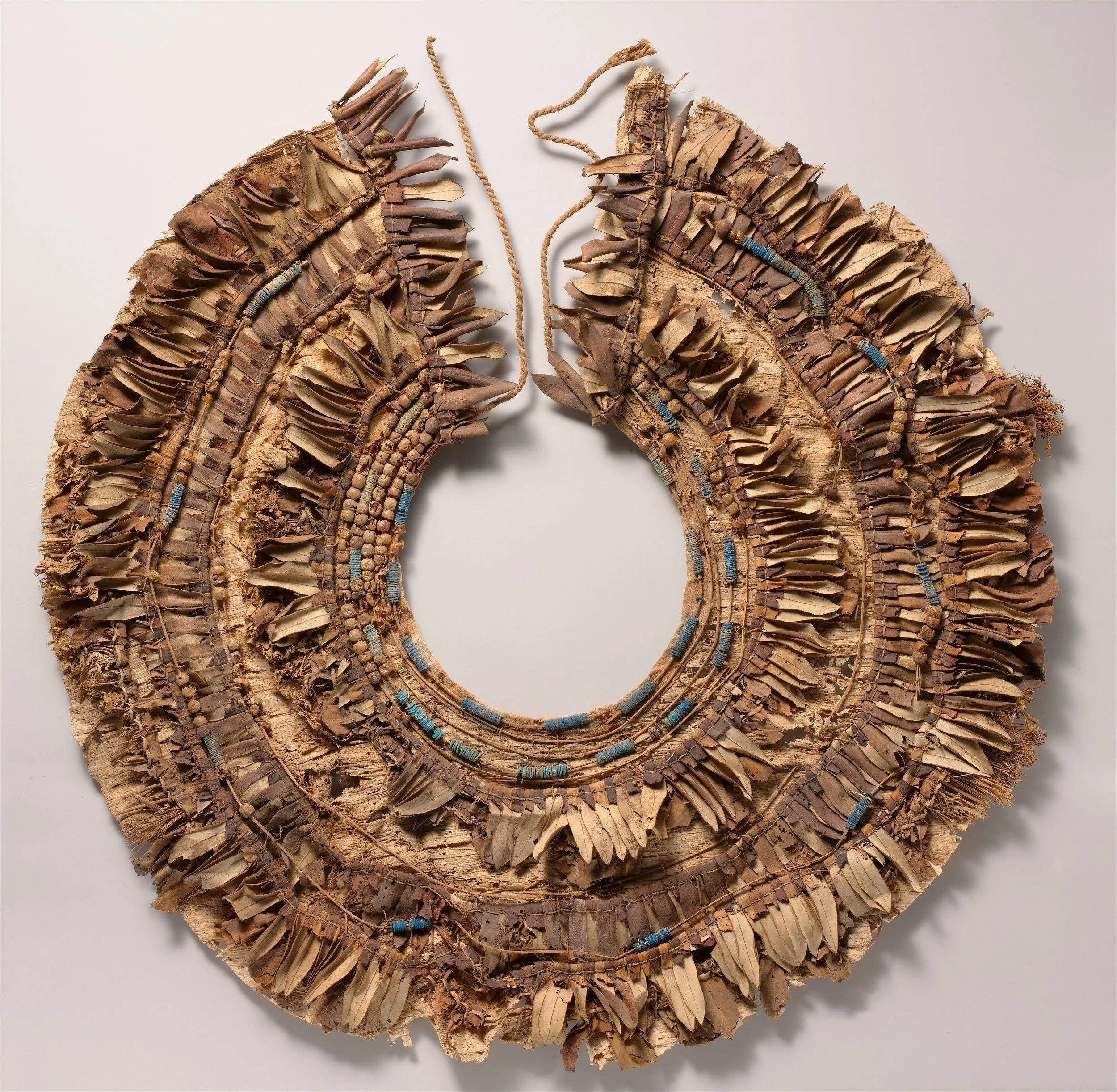
egyptian Floral collar from Tutankhamun's Embalming Cache, the metropolitan museum of art COLLECTION
A flower begins as a seed in the earth. With time, water and sun, it grows, its bright and colourful parts please the eye. It carries pollen and a scent. Humans throughout history have long been attracted by the beauty and power of flowers. They found many ways to be in their company. In Egypt, flowers honoured the living at banquets and went into the tomb with the dead, easing the passage out of one life and into the next. In Ming China, arranging stems in a vase became a discipline of attention. In the Andes, families grow them, carry them, and hand the knowledge down keeping farming and traditions alive.
In the Egyptian Valley of the Kings
Egyptian floral collars are among the more surprising survivals from the ancient world. Called wesekh by the Egyptians, literally meaning "the broad one” according to Brooklyn Museum, these collars of petals and leaves were sewn to papyrus and tied at the neck. Some have lasted more than 3,000 years in the dry air of Thebes.
It’s in 1907 that the archeologist Theodore Davis's team first found these fascinating wide semicircular bands, in a small pit in the Valley of the Kings (KV54). Egyptian floral collars are made from papyrus with makers stitched concentric rows of plant material, with folded olive, persea leaves, blue water lily petals, cornflowers, nightshade berries, and sometimes small faience beads. In a civilization preoccupied by the afterlife, the blue water lily or blue Egyptian lotus, which closes at dusk and reopens at dawn, symbolises rebirth. The same collars appear in Theban banquet scenes, worn by guests alongside lotus blossoms held to the nose, belonging to celebration as much as to death. This discovery held the embalming cache from Tutankhamun's funeral: natron, linen, pottery, animal bones, and the floral collars from the funerary banquet.
A few years later, in 1922, the British archeologist Howard Carter found Tutankhamun's coffins (KV62). The coffins contained real floral material, a small wreath of olive leaves, blue water lily petals, and cornflowers looped around the vulture and cobra on the brow of the second coffin, the "wreath of justification” which marks the deceased as having passed judgment before Osiris in Books of Going Forth by Day (commonly known as the Ancient Egyptian Book of the Dead). Larger floral collars were ornamenting the shoulders of the second and third coffins, sewn onto backing in the same concentric rows as the beaded ones. Garlands and bouquets were scattered elsewhere in the tomb. These collars served as symbols of status and protection believed to help resurrection in the afterlife.
Today, these floral collars are in museums collections in New York and Cairo.
A Chinese Ming official who grew tired of his desk
“Having eschewed the pleasures of both song and sex, it is to the mountains and the rivers, to flowers and to bamboo that the mind of the recluse of grace and learning turns in pursuit of its divertissements. Mountains and rivers, flowers and bamboo invoke no questions of fame or reputation and lie quite beyond the reach of our impatient scramblings for fortune.” Yuan Hongdao, ‘A History of the Vase’ (Ping Shi (瓶史)), 1599. Translated by Duncan Campbell.
Yuan Hongdao (袁宏道) was an instructor in the Directorate of Education in the Chinese Capital, Beijing during the late Ming Dynasty. Bored by office life, he decided to cultivate flowers, wander in nature and explore the art of flowers. In an essay, written during the 27th year of the reign of the Wanli Emperor, he offers an extraordinary perspective on a simple act: that of arranging flowers in a vase.
Flower arrangement (chahua, 插花) is a spiritual practice, a form of meditation or mindfulness in recognition of life’s temporary beauty. As Yuan Hongdao defines detailed steps and rules on practicing floral arrangement, the step of bathing of flowers is particularly poetic: “Just as flowers experience their own gamut of emotions, from that of happiness to that of anger, so too do they have their periods of wakefulness and of sleep, their own “dawns” and their own “dusks”, and if the efforts of the flower-bathers are to serve as life-giving rain, they need to accord with the flowers’ own schedules.” It’s recognizing that flowers have a soul. They also deserve respect. “Clear windows”, “spotless side tables”, “a visiting monk conversant in the art of brewing tea” or “houseguests skilled in painting flowers” are things that are ‘bringing pleasure to the flowers”. “A philistine who makes an unannounced appearance”, “twisted branches or false declarations of love” are amongst the 23 things that “defile” flowers.
Over time, China's chahua (插花) developed four distinct social strands of arrangement, folk, temple, court and literati, of which the literati tradition became one of the Song "four arts" and produced the Ming treatises, including Yuan Hongdao's. Nearly extinguished by the late Qing, it was revived after Reform and Opening and entered China's national intangible cultural heritage list in 2008. In Korea, gungjung chaehwa (궁중채화) were elaborate artificial flowers of silk, ramie, dyed paper and beeswax, made by court artisans for royal banquets and rites. Joseon-period values held against cutting living flowers for decoration, so the court commissioned these instead, sometimes at extraordinary scale (nearly 12,000 blooms for a single 1795 event). In Japan, flower arrangement is called Ikebana (生け花) meaning giving life to flowers in a decorative context. Kado (華道 or 花道) is the actual way of flowers which has a spiritual connotation and originates from buddhist offering practices to deities at temple altars. Kado has several institutional lineages. Ikenobo is the oldest and traced to the Rokkakudo temple in Kyoto, with a documented teaching tradition from the 15th century, and the originator of the rikka (立花) style. Ohara, founded 1895, introduced moribana, arrangements massed in shallow open containers, and absorbed Western flowers as Japan opened up and Sogetsu, founded 1927 by Teshigahara Sofu, considers that anyone can arrange anything, anywhere, with any material.
Flower arrangement remains a wonderful practice to connect our mind with beauty and the ephemerality of life. And in line with the Buddhist concept of impermanence, beauty can be found not only in the flourishing flower but in the withered branch too. Each of us can find our own way to it.
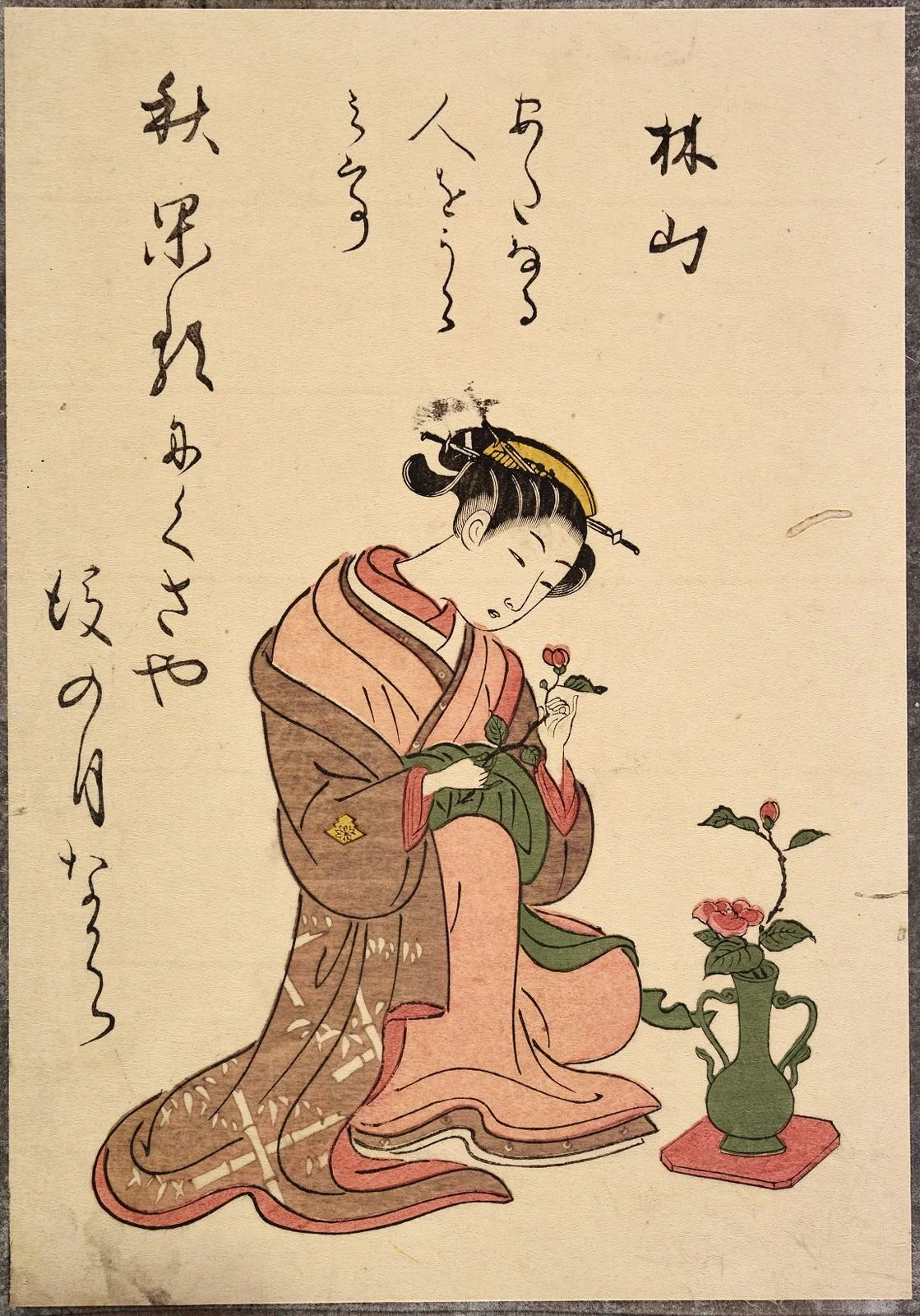
Lady arranging flowers, Suzuki, Harunobu, 1725?-1770 (PRINTMAKER). The Miriam and Ira D. Wallach Division of Art, Prints and Photographs: Print Collection, The New York Public Library digital collections. 1770.
Carrying flowers for generations
In the Andes, the Silleteros of Santa Elena have an old tradition of carrying flowers. Santa Elena is a rural corregimiento in the mountains above Medellín, Colombia, and their annual descent into the city closes the Feria de las Flores, one of the country's biggest cultural festivals.
The name Silleteros comes from silleta meaning "little chair". It is a wooden frame strapped to a porter's back, a practice with pre-Hispanic indigenous origins, later taken up by the Spanish for both transport and social display. In time the chairs were repurposed for cargo, and the farmers of Santa Elena used them to haul fruit, vegetables, and flowers down to the Placita de Flores, Medellín's flower market, founded in 1891 and still open today.
Now the silletas carry art. Using more than eighty flower varieties, Silleteros build landscapes, portraits, and messages honoring their values from one generation to the next. The flower parade is believed to have originated in 1807, according to the historian Germán Suárez Escudero, as one of the inaugurations of the Veracruz temple. In 1957, these parades inaugurated the first Feria de las Flores and have been held annually since. Building a floral creation is a household project: the family growing the flowers, planning the design, and assembling the frame. In 2015, the tradition was declared national cultural heritage.
In 2025, the Desfile de Silleteros counted 540 participants drawn from more than 200 families, including 100 children. A siletta weighs between 15 and 120 kilos and requires weeks of collective preparation in the farms. Children have their own parade, as a safeguarding plan by the Corporación de Silleteros to encourage them to take ownership of their culture and preserve it for generations.
Cultivating and arranging flowers is a way to honour and celebrate life and death: being with flowers and treating them well, using them to help the passage to an afterlife, and perpetuating traditions like farming recognizing the importance of intergenerational traditional agricultural practices. A flower is the seed-making part of a flowering plant. Its main function is to help the plant make new plants through reproduction, just like civilisations and societies carry on or propagate themselves.
Written by Mathilde Okuda, with Claude AI assistance (research)
References
Alcaldía de Medellín, medellin.gov.co
Books of Going Forth by Day / Book of the Dead: A Guidebook to the afterlife, a collection of funerary spells, prayers, and magical texts compiled by numerous anonymous priests and scribes over centuries
Brooklyn Museum, Broad Collar (40.522)
Duncan Campbell, Yuan Hongdao’s A History of the Vase (Ping Shi (瓶史). New Zealand Journal of Asian Studies, published on January 1, 2003
El Colombiano, Desfile de Silleteros 2025: edición 68
JAANUS, Japanese Architecture and Art Net User System, ikebana 生け花
The Metropolitan Museum of Art, Floral collar from Tutankhamun's Embalming Cache, (accession 09.184.216)
The Metropolitan Museum of Art, Tutankhamun's Funeral (online essay, drawing on Winlock and Arnold, Tutankhamun's Funeral, 2010)
Ministerio de Cultura de Colombia, Resolución 1843 de 2015