
Land Secrets In Oman
Set into the Oman’s Hajar Mountains, the village of Al Suwgra is shaped by one of the most remarkable geological landscape in the world. Around 500 years ago, the Al Sheriqi tribe settled here, building homes carved into the cliffs and cultivating the land using the ancestral aflaj irrigation system. As climate and living conditions are changing, the tribe is exploring new ways to sustain and preserve the village by sharing its history and traditions.
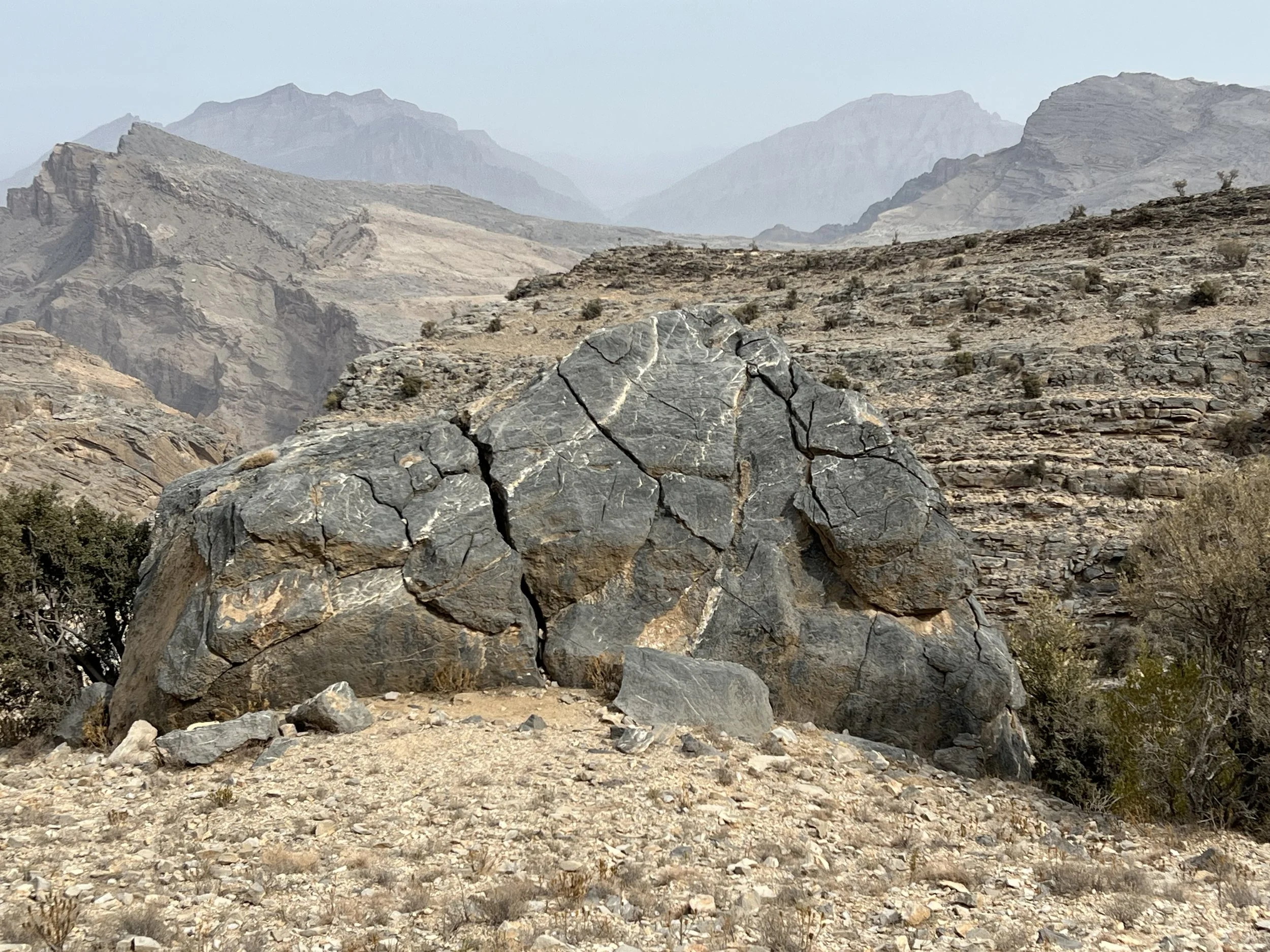
Oman ophiolite, ancient oceanic crust, Hajar Mountains
Situated at the meeting point of the Arabian and Asian plates, Oman holds one of the most remarkable geological landscapes in the world. In the north, the Hajar Mountains rise in layers of ophiolite and limestone, their steep slopes are shaped by cliffs and scattered oases. These ancient formations once fed many of the country’s groundwater aquifers. The Oman ophiolite is widely recognised as one of the most complete and best-preserved sections of oceanic crust exposed on land. Oman’s geology includes Precambrian rocks alongside Palaeozoic, Mesozoic, and Cenozoic deposits, tracing a deep geological and ancient history of 800 million years.
With this geology and climate, access to water and the shelter of mountain cliffs were essential considerations for ancient tribes to choose where to settle. Water sustains life. Carved into the rock, cliffside caves offered refuge from harsh temperatures. Their remoteness provided safety from tribal conflict. Around 500 years ago, the Al Sheriqi tribe, migrating from Yemen, settled in the village of Al Suwgra (also spelled Al Sogara or Al Suwjara), a secluded area of Jebel Akhdar in the Hajar Mountains within today’s Ad Dakhiliyah Governorate. For centuries, this region remained difficult to access, preserving its isolation and way of life.
It is said that the Al Sheriqi tribe settled in this place some 500 years ago after their ancestor, Rashid bin Salim bin Rashid Al Sheriqi, purchased land from the Imam Sultan bin Saif bin Sultan Sayyid Bilarab bin Imam Sultan bin Saif bin Sultan Al Ya’rubi. The settlement was established at an elevation of over 2,000 metres, where six families eventually lived together, sharing the land and its resources. Their descendants continue to inhabit the same place. Other tribes, including Bani Karus, Al Ya’ariba, and the Fahdis, also inhabited the region.
The Al Sheriqi families grew and built a cluster of homes built directly into the limestone cliffs and connected by a single staircase. Cave-like rooms were carved into the rock, with added walls made from local clay mixed with water and camel hair. This construction provides natural insulation from cold winters and hot summer avoiding the need to transport materials from afar. Men lived on one side, along the passage used by herds moving toward the mountains, allowing them to monitor access to the mountains. Women and children lived on the opposite side, closer to the cliffs, which offer shelter and protection. From the tower house in the middle of the village, a member of the tribe would survey the arrival of unexpected visitors. The caves served as refuge for livestock, goats and donkeys, protecting them from wild animals and harsh weather.
In this arid environment, access to water is crucial. In the North of Oman, harvesting is made possible thanks to the development of a remarkable innovation, the aflaj irrigation system. It is more than 3,000 years old and is still in use today. Recognised by the UNESCO World Heritage Convention, the aflaj irrigation system is an advanced form of water management designed to sustain communities and maintain peace in places with scarce availability of water. Using gravity, water flows through channels and is distributed to agricultural plots in carefully timed sequences. Stones are lifted at allocated moments, allowing water to reach each allotment in turn. Each falaj is overseen by a supervisor called Wakil al-Falaj in Arabic. His role is to ensure that schedules are respected and that water is shared fairly.
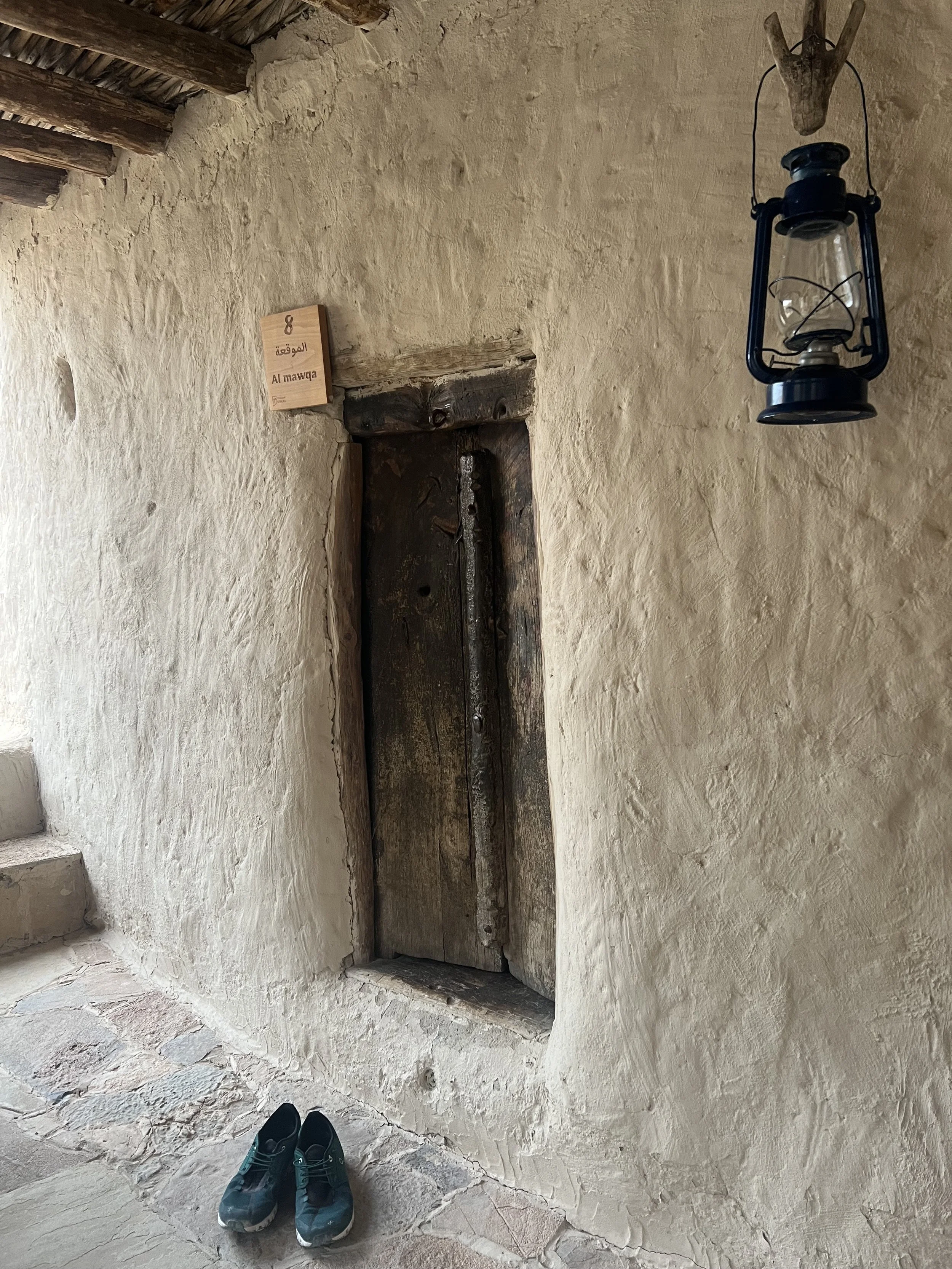
Small doors help preserve insulation and conserve wood.
In Al Suwgra, where the water is drawn from natural spring, the aflaj system made it possible to cultivate pomegranates, apricots, peaches, figs, walnuts, thyme, and wild roses.The tribe also raises sheep, goats, and donkeys that graze at high altitudes. The mountains are home to evergreen juniper trees (Juniperus excels), used for construction due to their resistance to termites, until the species was recognised as ecologically important and placed under conservation by the Omani Environmental Agency. Other native trees include wild olive (Olea europaea subsp. cuspidata), acacias (Acacia gerrardii), fig trees (Ficus cordata, Ficus johannis), and moringa (Moringa peregrina).These precious resources are used for consumption and trade. In the past and until 2004, harvested goods were carried by mules on a two-day journey across the mountains to the local souk, where they were sold to buy other essential supplies such as rice and dates. However, during the past ten years, harvesting is becoming increasingly unpredictable as global warming intensifies water scarcity. In some years, pomegranates fail to grow entirely, disrupting the traditional way of life and creating uncertainty. Today, the community has to rely increasingly on expensive desalinated water purchased from the government and delivered through pipelines. This new dependency significantly affects the management of resources and the organisation of harvesting practices.
In 2004, life in Al Suwgra began to change. The government subsidized the construction of a road connecting the village to the ‘outside world’. While harvesting activities continued, the families started to have direct access to modern transportation. Three years later, more change came with the installation of a cable between the two cliffs, making it easier to bring goods to and from the village. Interest from visitors slowly grew and the tribe began to welcome guests occasionally. Until they started to imagine the creation of an heritage inn to preserve the village, their ancient culture and traditions and mitigate the increasing uncertainty of harvesting.That encounter stayed with me. It made me reflect on how many different ways there are to make, and how a designer’s or artist’s intention and approach may take very different paths toward something essential.
“When the younger generation first suggested transforming the village into an heritage inn, our elders met the idea with scepticism and refusal,” explains Mohammed Al Sheriqi, the manager of the project. “But faced with the prospect of seeing our ancestral village fall into ruin, they slowly began to accept the idea, under conditions and rules designed to ensure the preservation of our traditions and culture.” These included a limited number of rooms and the respect of religious and spiritual practices. “There were many discussions and disagreements between us, but in the end, reaching consensus was essential for the project to succeed. Other villages struggle to do the same because families have difficulties to agree and move forward together”, he added.
The vision of creating an authentic experience and sharing their ancient traditions generously also drew the attention of large hospitality companies, some of which offered to invest in the project. However, led by the elders, the tribe chose to follow their own path. “We were approached by a few big companies. But we decided to decline their offers because we did not want to have to make compromises”, explains Hilal Al Sheriqi, a family member of the tribe. “It was important for us to find our own way to preserve the traditions of our tribe. It required a lot of trial and error, patience, time and effort. And we really enjoyed the process”, added Hilal Al Sheriqi with a smile. The village, as it exists today, took nearly twenty years to build and shape. It was only recently in 2014 that the last family moved out of the cliffside to a nearby modern houses compound joining the other families.
Perhaps the secret to keeping traditions alive and protecting ancient spirit lives in something deeply human: resilience, collective wisdom, and the ability to shape a life wherever the land allows it. By offering a glimpse into how people lived for centuries, Al Suwgra feels like a living memory. To walk through the village is to step into timelessness, as if you’ve been invited into a secret that the Al Sheriqi tribe and the mountains are keeping carefully.