
Conversation Series - A Dialogue around ‘Flames with Moisture: Candle Object’
In this new conversation series of maison tombo Journal, the founder of maison tombo, Mathilde Okuda, and the Taiwanese designer Chialing Chang are exchanging thoughts about the creative process, the role of objects and the poetic frontier between the visible and the invisible.
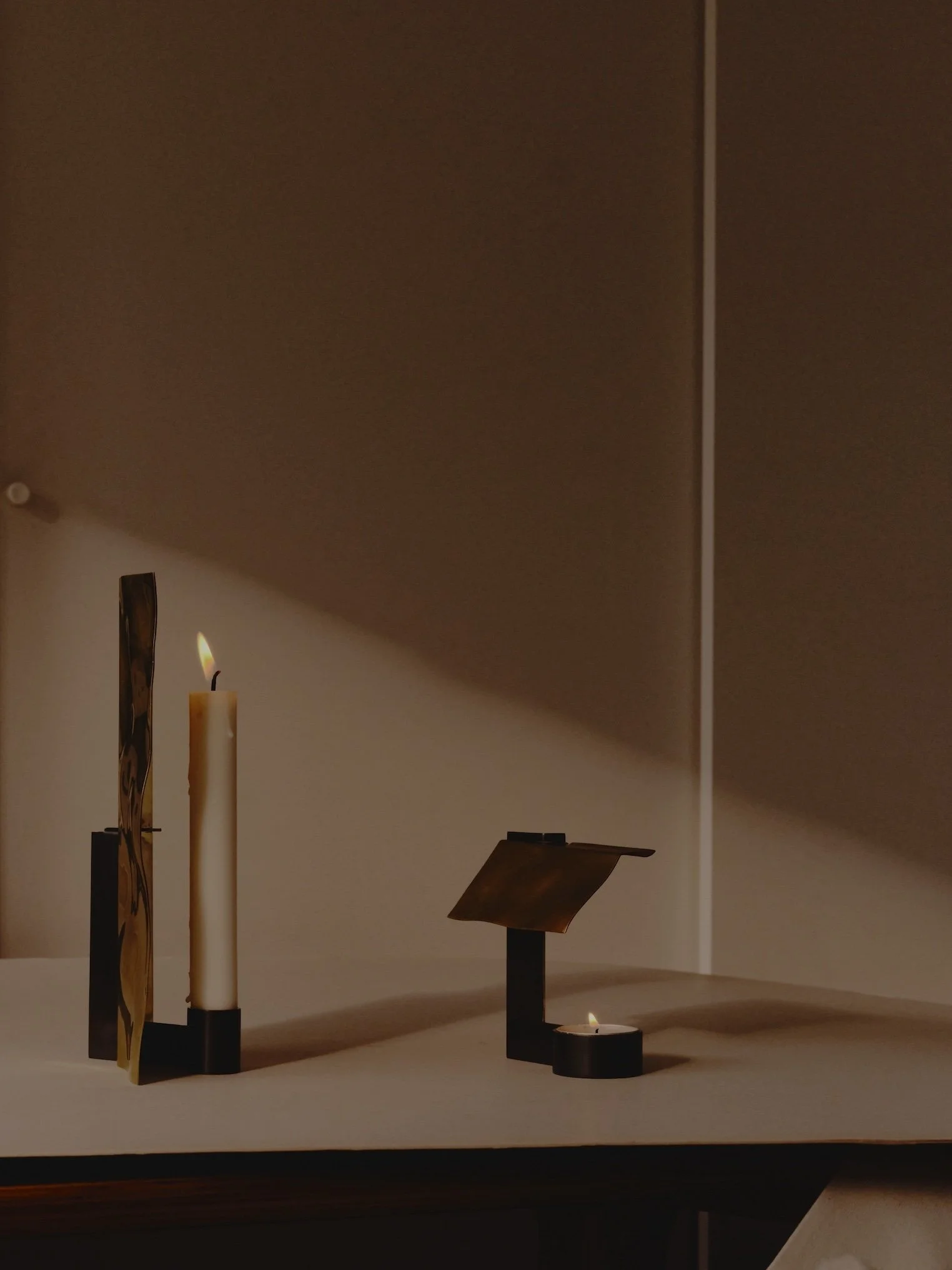
flames with moisture: candle object - photography ©2023 Yuhao chang
Mathilde: contemplating Flames with Moisture: Candle Object that you created back in 2023, a gentle feeling of care and protection arises. The upper structure, almost like a roof, seems to shelter the flame, guarding it so that it may continue to give light. Meanwhile, the object’s shadows shift throughout the day, responding to changes in its surroundings. It feels as though the candle and the ambient light engage in a gentle dialogue: the object generates light for the viewer or seer, while the surrounding light, in turn, casts and transforms its shadows.
Through this interplay of illumination and obscurity, something emerges where the visible and the invisible meet, where what can be seen and what remains hidden coexist in a delicate balance. Within this experience, something ineffable happens, a perception that resists articulation. As Maurice Merleau-Ponty writes in the Visible and the Invisible, the invisible is not a separate, spectral realm, but the very depth, sense, and latent structure that are folded within what is seen. How then, might we approach describing this depth? And should we even try?
Chialing: it is interesting you brought this up. I recently revisited a passage in Merleau-Ponty’s Eye and Mind, where he reflects on how we perceive the depth of water. Depth, he suggests, does not arrive through reasoning, but through the way our bodies inhabit the world. What appears to us is a subtle vibration between the visible and the not-yet-visible. The surface of the water, the shifting light, and the quiet patterns beneath it fold into one another, letting depth reveal itself as something continuously coming into being.
I am still taking in these ideas. Yet when I think about my own work, I notice how little begins with concepts. The process is almost always intuitive. With the tealight from 2023, I often found myself simply watching the flame—sometimes for a long while. In that gentle, trance-like attention, I sensed a kind of fluidity inside the movement of the flame. Its flicker felt like a vertical stream of water. Through this piece, I wanted to share that experience, that moment of association.
The roof-like element you mentioned was originally imagined as a reflector. I hoped it would catch the trembling light and send it outward, extending the presence of the flame into the viewer’s perception—the shifting brightness, the faint movements of air, the subtle changes in the environment.
Your interpretation of the piece is fascinating to me. Each viewer brings their own history and sensibilities to what they see, and meaning arises in that meeting. I feel that a work needs a certain openness—a space that invites others to complete it with their imagination. But that openness must still resonate with lived experience, so that perception itself becomes part of the encounter. Only then can such a space hold a kind of poetic intensity.
Mathilde: this question of our relationship with objects is fascinating, and it is one of the core ideas that led me to found maison tombo, it is a pillar of its concept. The objects we choose, or that unexpectedly question us, ignite the lived experience you describe, provided there is a certain openness, a space that suddenly collides with our senses and perceptions.
It begins with the way objects are created: the intention, intuition, and skills of the maker or creator. This is the essence of art or craftsmanship, where the creation carries a kind of soul, transmuted through energy, which meets the spectator and gives rise to that invisible yet palpable something you beautifully call poetic intensity, and which I described as a silent dialogue in the maison tombo’s concept.
It is almost as if two souls were meeting in a space that becomes intimate, allowing us to touch our deepest selves. The beauty of this is that the experience is intemporelle, or timeless in English. An object created a hundred years ago can continue to speak to us for centuries. It becomes sacred.
This could be one of the reasons we choose the objects we do, and why we visit museums or art galleries. These are spaces, often white, open, and devoid of anything that might distract from the encounter, that allow us to connect to our senses and our own intimacy almost secretly, to find a sense of belonging, and to seek an understanding of humanity and its origins through artifacts and art installations created by both our ancestors and contemporaries.
It is also tempting to say that this poetic intensity or silent dialogue might be one manifestation of what is called essence, as opposed to existence, which resonates with the concept of transcendental idealism developed by the philosopher Kant. According to this view, what can be known are objects as they appear (phenomena), shaped by our forms of intuition (space and time) and the categories of understanding, not things as they are in themselves.
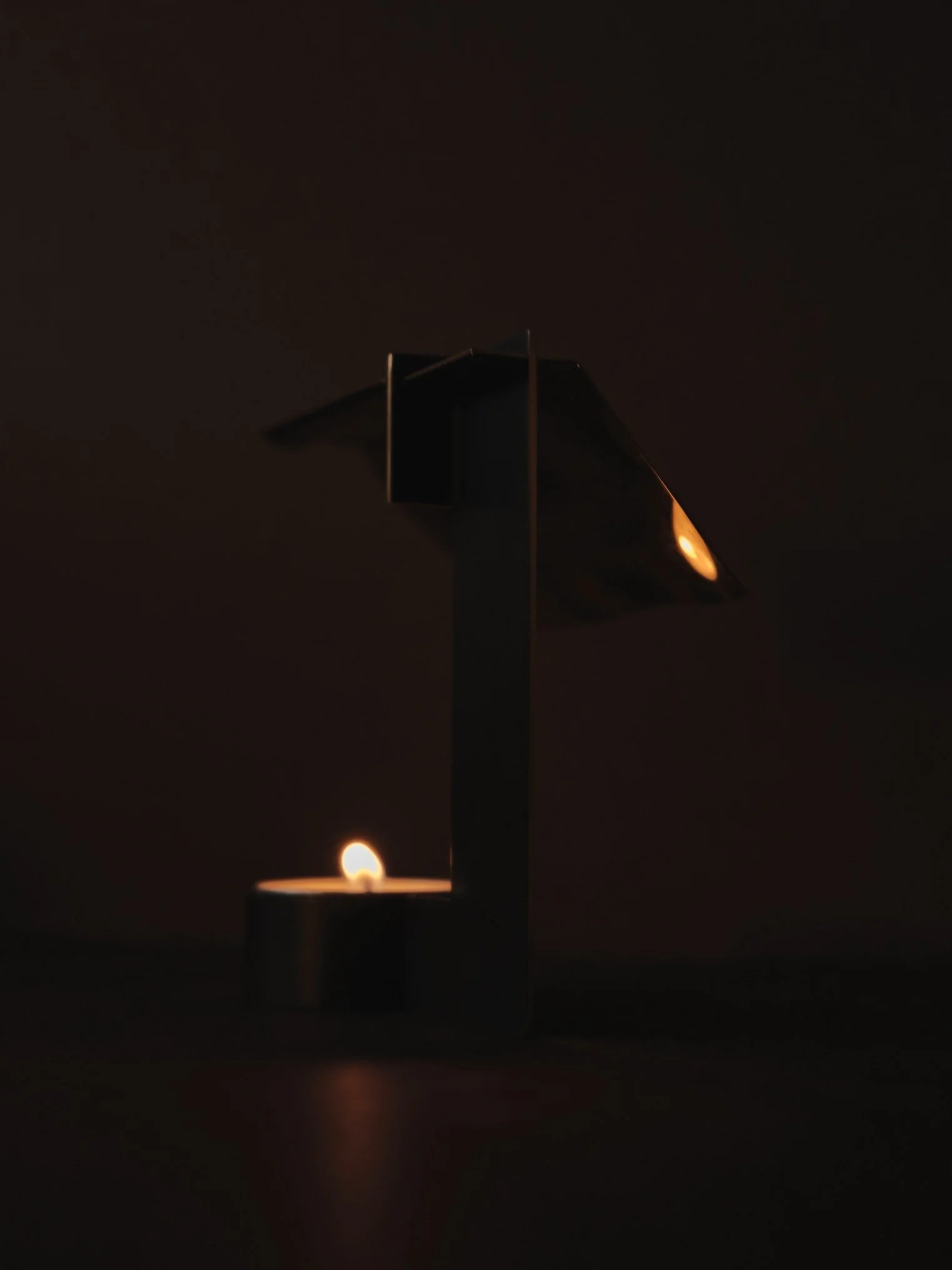
poetic intensity and silent dialogue - photography © 2023 Yuhao chang
Chialing: you are touching on things that are very difficult for me to put into words, yet they resonate deeply with my way of making. I often wonder what allows a work to endure over time. Perhaps it begins with a certain way of observing, thinking, or experiencing the world, and eventually takes on a form that can be sensed. This form does not need to be concrete or fixed. It may remain as an object, but it can also exist as a fleeting emotional vibration.
When I was developing Flames with Moistures candle object, I was thinking about a site-specific work by the Portuguese artist André Uerba, Burn Time. In this performance, cotton threads were suspended from a rotating circular structure and set on fire, one by one or simultaneously. Standing in the darkness, watching these small points of light slowly rise—like fireflies or floating dust—and then quietly disappear, I felt immersed in a situation that was constantly changing and fading.
That encounter stayed with me. It made me reflect on how many different ways there are to make, and how a designer’s or artist’s intention and approach may take very different paths toward something essential.
The experience was powerful, but what stayed with me most came afterward. When the performance ended and the lights returned, the work the artist had spent so much time and care creating had completely burned away. At that moment, I became aware of a difference between his practice and mine. Through my work, I try to give form to an experience I once had, allowing it to remain in a physical object. What he sought to create was the experience itself.
Mathilde: the inspiration you drew from André Uerba’s performance and the creative process that led to the Flames with Moisture: Candle Object feels deeply perceptive. You describe it beautifully, and yet, as I read it, I sense a feeling that’s hard to articulate. And so, yes, objects invite experiences or phenomena, at a particular moment, during their making, in their use or even in their destruction. Through our senses, they materialize and dematerialize in the flow of that experience. As philosopher Edmund Husserl suggests, things gain their meaning only through our experience of them. To feel and appreciate that experience, the cultivation of awareness is necessary, and that is where the beauty of life resides.
Consider, for instance, the simple act of drinking tea. Preparing it with intention, pouring it into a cup crafted from earthy materials that enhance its flavor, feeling the warmth and the texture of the cup when lifting it, and savoring each sip, this transforms a routine action into a small daily ceremony, rich in awareness and care. I am curious about creating such an experience by bringing the Flames with Moisture: Candle Object together with the maison tombo Clouds and Water teapot.
Chialing: I can share a bit more about my process here. Often, it is only after I encounter certain qualities or phenomena that I decide on the form a work will take. When I discovered the textures that emerge from hammered brass, and how they reflect light in wave-like patterns when paired with a light source, I felt the need to design a lamp or a candle object. From this perspective, I sometimes think about the function of an object only at the very end, because for me, practical use is not always the first priority in making.
What I return to more often is space: the atmosphere within a space, a particular sense of time or state of duration, and the metaphors that arise when these elements come together. When I read your description of bringing Flames with Moisture: Candle Object together with maison tombo’s Clouds and Water teapot, the image that came to mind was indeed ritual-like, much as you described. Each step unfolds slowly. These gestures remain closely tied to everyday life, yet through use, the objects move beyond the ordinary and become something more abstract, something that does not ask to be explained.
When I imagine the candle object alongside a tea setting, their meaning lies in their ability to open the senses of those who take part. I am drawn to objects not only for their metaphysical function, but for their capacity to open multiple layers of association within the person living with them.
Mathilde: thank you Chialing, for sharing your insights and for this poetic dialogue!