
Nyepi: A Day of Sacred Silence to Restore Harmony
Imagine a place where, for one full day each year, life as we know it simply stops. The streets fall silent, the lights disappear, and the island turns inward, embracing stillness as a way to restore harmony in the world.
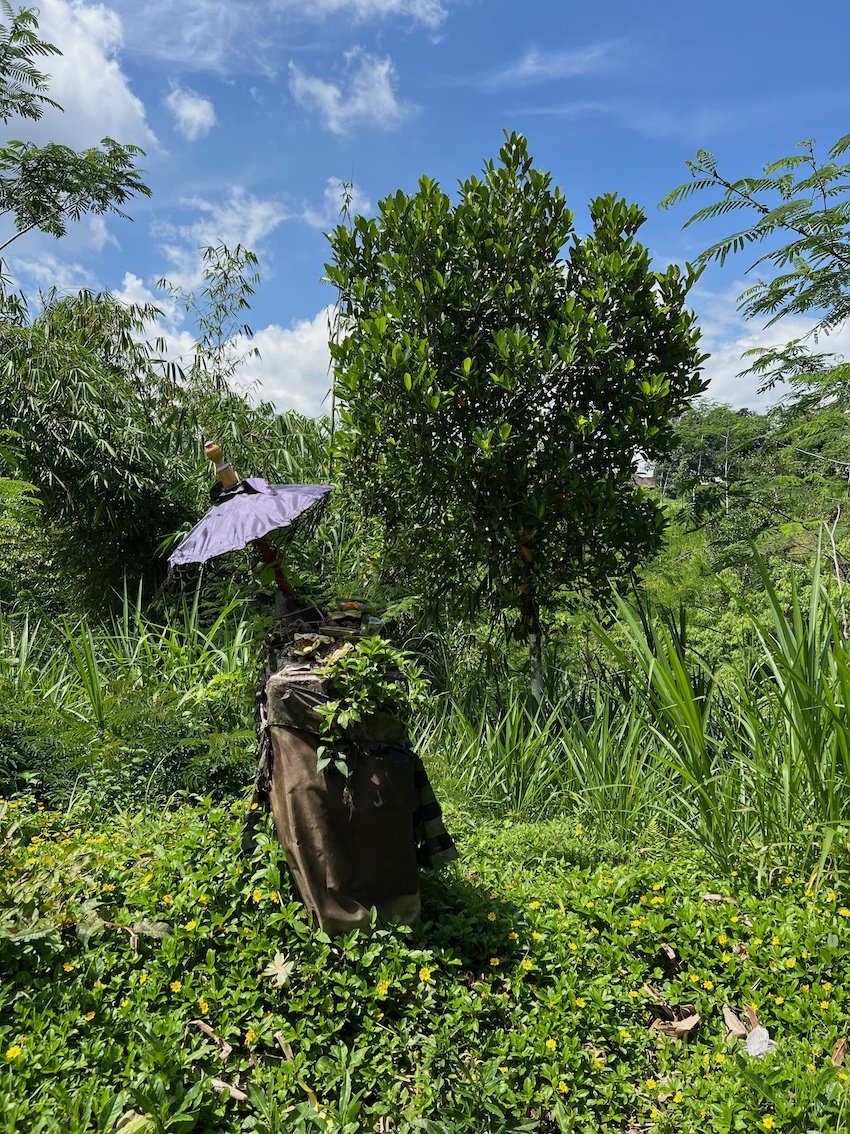
tedung, used in ceremonies, ARE sacred umbrellas symbolising DIVINE protection- photo ©2026 maison tombo
Imagine waking with the first light of dawn, knowing that the day ahead will unfold in complete silence until the next morning. The only sounds that you hear are those coming from the natural world: the wind moving through the trees, maybe the rain touching the earth, birds singing, cicadas or frogs murmuring somewhere outside. And sometimes, when listening attentively, the sound of silence itself.
Beyond houses, the streets are empty. Shops, markets, cafés, restaurants, banks, and public spaces have all closed their doors. No cars are running their engines on the roads, no planes are flying across the sky. Stations and airports stand still. The Wi-Fi network is silent. Electricity is set aside for a moment without appliances, computers, or phones.
At home, families refrain from speaking. There are no cooking fires. The day is for resting: to sit quietly, read, perhaps meditate. You are in your own company, held by the quiet and the silence becomes a space for reflection.
Once a year, in the month of March, such a day unfolds on the island of Bali, Indonesia. It is called Nyepi, a term associated with Sepi in Balinese language, literally meaning ‘withdrawing into silence’. Nyepi marks the beginning of the Saka New Year in Balinese Hinduism, (Tahun Baru Saka). Unique in the world, this ritual comes from the traditions of Balinese Hinduism, where silence is a sacred space in which balance can be restored. The Saka calendar originated from India around 78 CE and was introduced in Bali around the 8th century. Hinduism gradually evolved through the influence of local animist traditions and Buddhism, particularly during the periods of the Srivijaya and Majapahit kingdoms to become the religion that is known today as Balinese Hinduism.
The passage to the New Year is dedicated to restoring harmony between humans, nature, and the divine, an ideal embodied in the Balinese philosophy of Tri Hita Karana. Nyepi is understood as a profound spiritual cleansing, a kind of cosmic reset achieved by neutralizing chaotic energies known as Bhuta Kala, the spirits of disorder. In religious practice, Nyepi is guided by four sacred restrictions. Amati Geni forbids fire and light, Amati Karya calls for the cessation of work, Amati Lelungan prohibits travel and Amati Lelanguan asks people to refrain from entertainment or pleasure. Together, these observances create a day devoted to tapa brata yoga semadi, a state of ascetic self-restraint, meditation, and spiritual discipline.
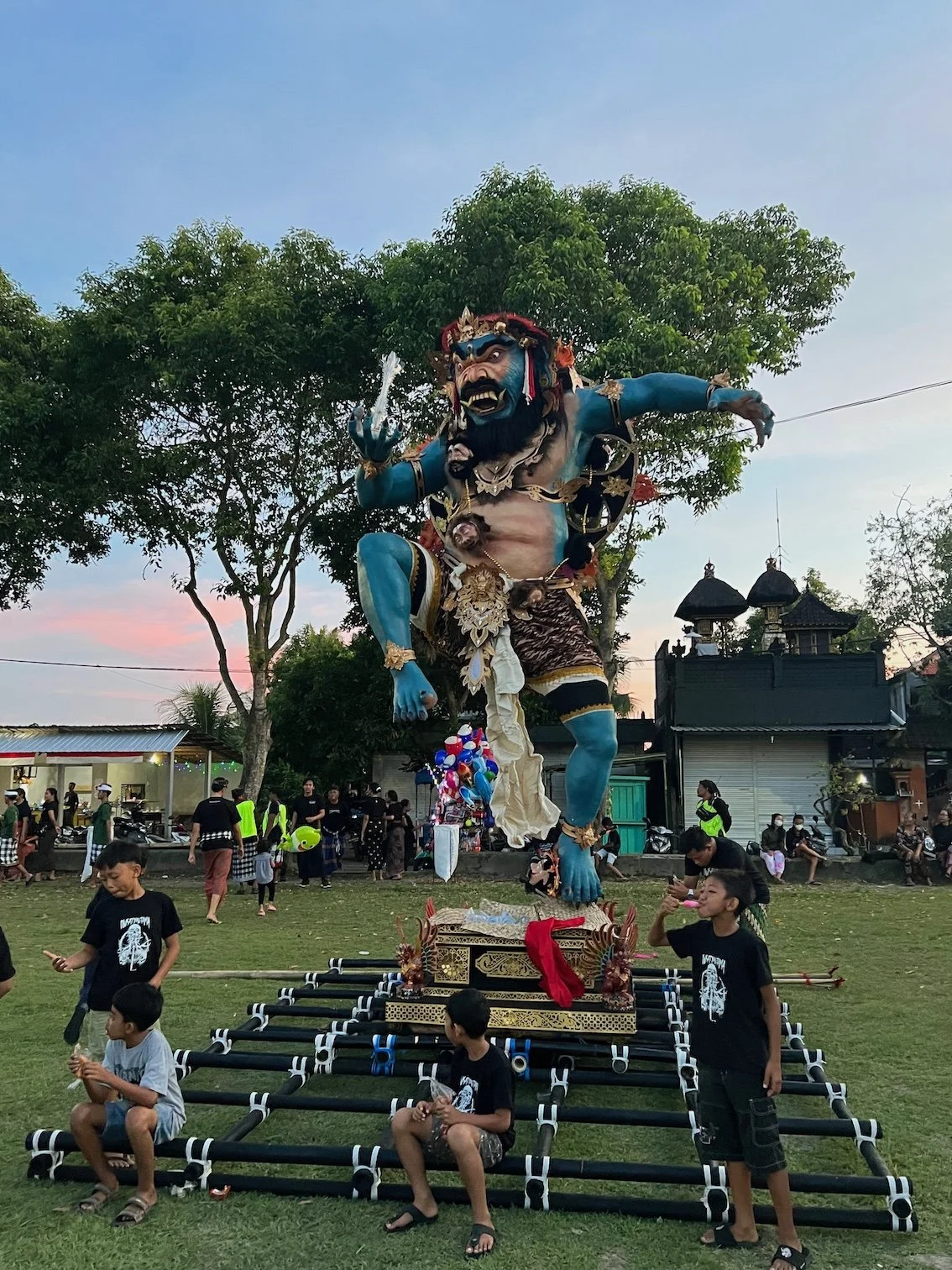
before nyepi, balinese celebrate the ogoh-ogoh day, Pengerupukan. children are waiting for the parade to start. photo ©2026 maison tombo
Like any sacred ritual, Nyepi requires careful preparation. Weeks before, young Balinese begin crafting Ogoh-Ogoh, large sculptural effigies meant to embody evil spirits. Some depict traditional demons drawn from Hindu mythology, others take on modern forms, offering satirical interpretations of political figures, social issues, or popular characters. All are designed to frighten and symbolically drive away negative forces.
In preparation for this sacred day and the coming New Year, purification is a must and it is performed by Balinese Hindus priests through ceremonies called Melasti. Communities process from their temples to the sea, a lake, or a sacred spring, carrying holy temple objects, offerings, and ceremonial umbrellas (Tedung). Priests perform prayers and purification rites near the water. Water is central to the ceremony because it is believed to possess the power to cleanse negative energies and restore spiritual balance. Through bathing, prayers, and offerings, people symbolically purify their bodies, their minds, and the sacred objects of the temples before entering the silent day celebrating the New Year.
On the eve of Nyepi, Balinese celebrate the Ogoh-Ogoh Day, called Pengerupukan. The island erupts into a final burst of energy. Communities gather for vibrant parades where each neighborhood presents its Ogoh-Ogoh. Accompanied by rhythms of gamelan music, youth groups carry the giant figures on bamboo platforms through the streets. At crossroads, the effigies are spun and shaken, a ritual gesture meant to confuse the spirits of chaos. At dawn the following morning, Nyepi begins. For twenty-four hours, the island of Bali falls into complete stillness.
The following day, life slowly returns to its rhythm through a practice known as Dharma Shanti. People visit family, friends, and neighbors, asking for forgiveness and offering it in return. It is a moment of reconciliation, of restoring social harmony, so that the new year may begin with a spirit that is clear and renewed.
This year, according to the Gregorian calendar, Bali will offer itself to silence on March 19 at 5:59am until March 20 at 6:00am. For twenty-four hours, the island will pause in stillness marking the beginning of the Saka New Year 1947–1948 and offering quiet restoration of harmony in the world.